Spine problems demand a particular kind of medical care — careful, considered, and conservative. Unlike many surgical specialties where the right answer is often clear, spine treatment lives in nuance. The same MRI finding can mean very different things depending on a patient’s symptoms, lifestyle, and goals. The same back pain can need very different approaches in different people. That’s why choosing the spine hospital in Bangalore isn’t just about advanced technology — it’s about finding a place where evidence, experience, and patient-first thinking meet.
This guide is built for patients facing back, neck, or disc problems who want to make a calm, informed decision about where to seek care. Whether you’ve been told you might need spine surgery or you’re simply trying to understand persistent symptoms, these are the principles that separate a truly excellent spine hospital from a routine one.
Why Spine Care Is Different from Other Surgical Specialties
The spine is unique:
• It houses the spinal cord and nerve roots — vital, irreplaceable structures
• It supports almost every movement of the body
• Surgery decisions are often subjective — “could benefit” rather than “must operate”
• Most patients improve without surgery
• Recurrence and revision rates can be significant if poorly chosen
• Long-term outcomes depend heavily on rehab and lifestyle
For these reasons, the best spine hospitals are often the ones that operate the least — not the most. They identify the specific subset of patients who genuinely benefit from surgery and treat the rest with structured, conservative care.
Conditions Treated at a Top Spine Hospital
| Condition | Common Symptoms |
| Mechanical low back pain | Episodic, activity-related |
| Cervical / lumbar spondylosis | Stiffness, neck or back pain |
| Slipped (herniated) disc | Radiating leg or arm pain |
| Spinal stenosis | Pain on walking, eases with bending forward |
| Spondylolisthesis | Vertebra slipping over another |
| Sciatica | Sharp pain down the leg |
| Cervical radiculopathy | Pain radiating to arm |
| Spinal trauma / fractures | Acute injury |
| Compression fractures | Often osteoporotic in elderly |
| Spinal tumours | Less common but important |
| Spinal infections / TB | Persistent pain with systemic features |
| Scoliosis / kyphosis | Spine deformity, often progressive |
Qualities That Define the Top Spine Hospital
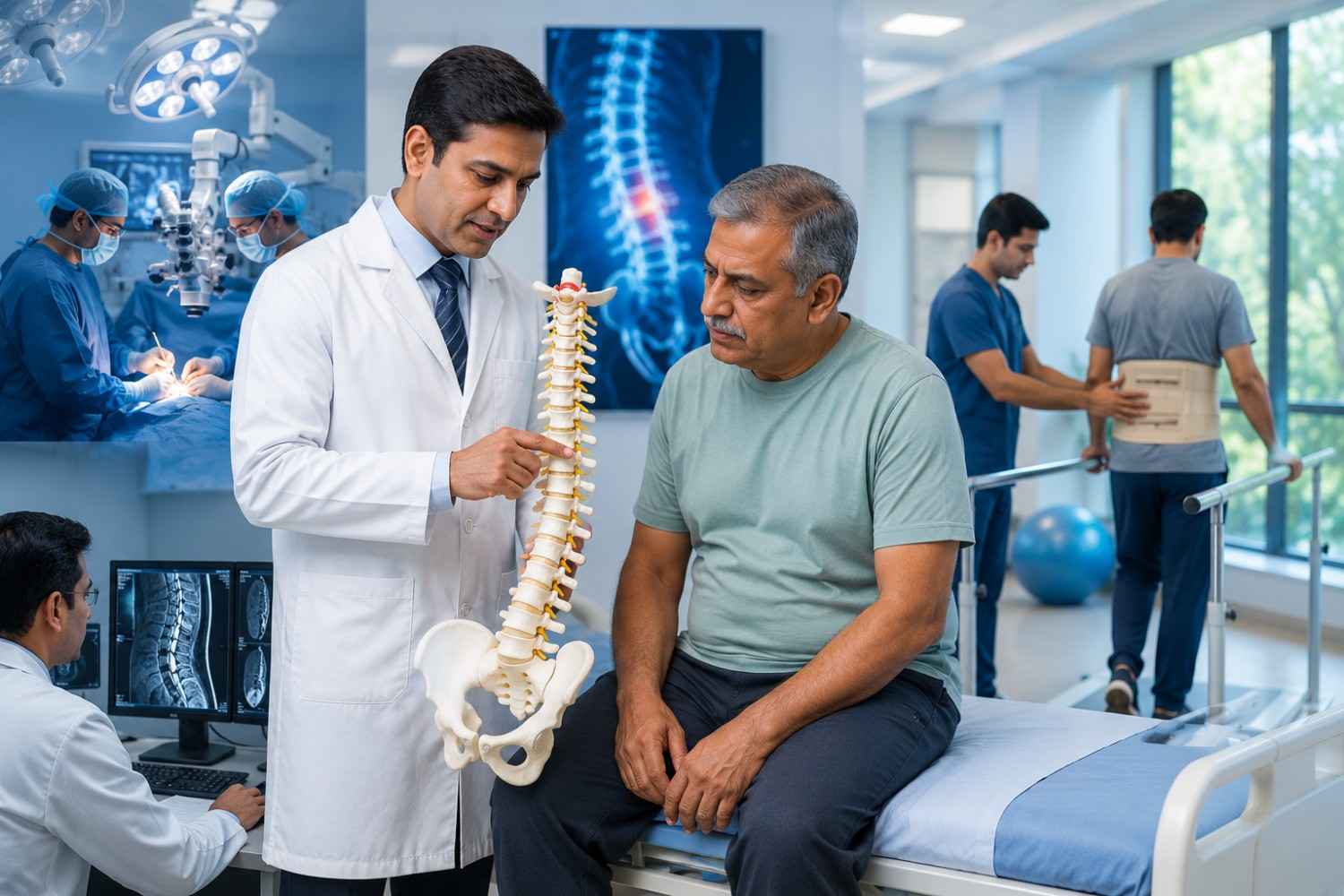
1. Multi-Specialty Spine Team
A truly excellent spine hospital combines:
• Orthopaedic spine surgeons
• Neurosurgeons (especially for cord-related issues)
• Pain management specialists
• Physiatrists / physiotherapists
• Rheumatologists (for inflammatory spine disease)
• Radiologists experienced in spine imaging
This team-based care ensures every patient is matched to the right treatment.
2. Conservative-First Philosophy
The top hospitals don’t push surgery. They:
• Rule out non-surgical causes thoroughly
• Try structured physiotherapy and pain management first
• Reserve surgery for clear, evidence-supported indications
• Help patients understand realistic outcomes
3. Modern Imaging
• High-resolution MRI
• Standing X-rays for alignment
• CT scans for complex bony pathology
• Image-guided injection capability
4. Minimally Invasive Spine Surgery (MISS)
When surgery is needed, modern MISS techniques offer:
• Smaller incisions
• Less muscle damage
• Shorter hospital stay
• Faster recovery
• Excellent outcomes when applied appropriately
5. Robotic / Navigation-Assisted Surgery
For complex spinal fusion or instrumentation, robotic and navigation systems improve precision and safety in selected cases.
6. Strong Rehabilitation Department
Without high-quality rehab, even the best surgery underperforms. Top hospitals have:
• Dedicated spine physiotherapy teams
• Structured pre-op and post-op protocols
• Ergonomic and lifestyle counselling
• Long-term follow-up support
7. Honest, Transparent Communication
You should leave a consultation knowing:
• Your exact diagnosis
• Whether surgery is truly indicated
• Realistic outcomes and risks
• Cost in writing
• Recovery timeline
The American Academy of Orthopaedic Surgeons and Mayo Clinic Spine Center outline the multidisciplinary standard that top spine programmes follow.
Conservative Treatment: Where Most Spine Care Begins
Most spine problems don’t need surgery. The conservative menu includes:
• Structured physiotherapy
• Core and spine-strengthening exercises
• Posture correction
• Ergonomic assessment
• Anti-inflammatory medication
• Targeted pain interventions (epidural injections, facet joint injections, RFA)
• Muscle relaxants
• Lifestyle modification — weight, smoking, sleep, stress
A trustworthy hospital fully exhausts these before recommending surgery.
When Surgery Becomes the Right Choice
Spine surgery is generally indicated when:
• Conservative care over 6–12 weeks has not adequately helped
• There’s significant nerve compression with weakness or numbness
• Bowel/bladder dysfunction occurs (urgent — cauda equina)
• Severe instability or deformity is present
• Quality of life is significantly impaired
• Imaging confirms a clearly correctable structural problem
The right surgery, in the right patient, at the right time delivers excellent outcomes.
Modern Spine Surgery Options
| Procedure | When It’s Used |
| Microdiscectomy | Disc herniation pressing on nerves |
| Laminectomy | Spinal stenosis with nerve compression |
| Spinal fusion | Instability or severe disc degeneration |
| Disc replacement | Selected single-level disc disease |
| Vertebroplasty / Kyphoplasty | Osteoporotic compression fractures |
| Endoscopic spine surgery | Selected disc problems via tiny incision |
| Robotic-assisted spinal fusion | Complex instrumentation |
Recovery Timeline After Spine Surgery
| Procedure | Typical Recovery |
| Microdiscectomy | Walking next day; office work in 2–4 weeks; full recovery 6–8 weeks |
| Laminectomy | Walking next day; full activity in 6–12 weeks |
| Spinal Fusion | 3–7 day stay; full recovery 3–6 months |
| Endoscopic Surgery | Day-care or 1-day stay; quick recovery |
Rehab is critical throughout.
Why Choose Ananya Hospitals as a Top Spine Hospital in Bengaluru
Ananya Hospitals provides comprehensive, evidence-based spine care under one roof. Patients from across Karnataka and neighbouring states choose us because:
• Senior spine specialists across orthopaedic, neurosurgical, and pain management disciplines
• Multi-disciplinary spine evaluation — no single-perspective decisions
• Conservative-first treatment philosophy
• In-house MRI, CT, and pain intervention facilities
• Minimally invasive spine surgery for selected cases
• Structured spine rehabilitation programmes
• Transparent, written cost estimates
• Cashless insurance support
• Multi-language patient counselling
Our orthopedics & spine department is structured around long-term outcomes, not aggressive intervention.
How to Choose the Right Spine Hospital — A Patient’s Checklist
When evaluating a hospital, ask:
• Who specifically will examine and treat me — an experienced spine specialist?
• What non-surgical options will be tried first?
• How many of this procedure does the surgeon perform yearly?
• What’s the conservative-to-surgical ratio at this hospital?
• What rehab support is provided post-surgery?
• Can I have a written cost estimate?
• What’s the readmission rate after spine surgery here?
Confident hospitals welcome these questions.
Lifestyle Habits That Genuinely Help
• Walk regularly — even 30 minutes daily
• Strengthen core muscles
• Maintain healthy weight
• Quit smoking — major contributor to disc degeneration
• Adjust ergonomics at work
• Sleep on a firm, supportive mattress
• Manage stress and sleep
• Address vitamin D and calcium deficiencies
FAQ
Q1. When should I see a spine specialist?
For pain or stiffness lasting beyond 4–6 weeks, radiating leg/arm symptoms, weakness, or any red flags like bladder/bowel changes.
Q2. Will I need surgery for a slipped disc?
Most slipped discs heal with structured physiotherapy and time. Surgery is reserved for severe nerve compression or persistent symptoms despite conservative care.
Q3. Is minimally invasive spine surgery as effective as traditional surgery?
For appropriate cases, yes — and often with faster recovery and less pain.
Q4. Are spinal injections safe?
Yes, when performed by trained specialists under image guidance. They can be highly effective for selected conditions.
Q5. How long does spine surgery take?
Microdiscectomy: 1–2 hours. Laminectomy: 2–3 hours. Fusion: 3–5 hours.
Q6. What’s the success rate of spine surgery?
Carefully selected patients have over 85–90% success rate. Patient selection is the most important factor.
Q7. Will I be paralysed if something goes wrong?
Serious neurological complications are rare in modern spine surgery, especially with experienced surgeons. Detailed pre-op discussions outline risks honestly.
Q8. How long is the hospital stay after spine surgery?
1–2 days for microdiscectomy; 3–7 days for fusion; usually 1 day for endoscopic procedures.
Q9. Does insurance cover spine surgery?
Yes, when medically indicated. Cashless coverage is standard.
Q10. How do I find the top spine hospital near me in Bangalore?
Look for multi-disciplinary spine teams, conservative-first approach, modern imaging and surgical capability, and structured rehab — all of which Ananya Hospitals provides.
Conclusion
The top spine hospital in Bangalore isn’t necessarily the one that operates the most or markets the loudest. It’s the one that listens carefully, evaluates thoroughly, recommends conservatively, and operates only when truly necessary — and then with experienced hands and modern techniques. For most spine patients, this approach delivers far better long-term outcomes than aggressive surgery.
If you’ve been struggling with persistent back or neck symptoms, please consider getting a multi-disciplinary opinion before deciding on treatment. The right path forward is rarely the first one suggested.
Book Your Consultation at Ananya Hospitals
Talk to our senior spine specialists in Bengaluru. We’ll examine you carefully, share an honest assessment, and recommend the most appropriate treatment for your specific situation.
Call us or book an appointment online. Visit: Ananya Hospitals, Bangalore Department: Orthopedics & Spine Care
Strong spine. Smart care. Long-term mobility.