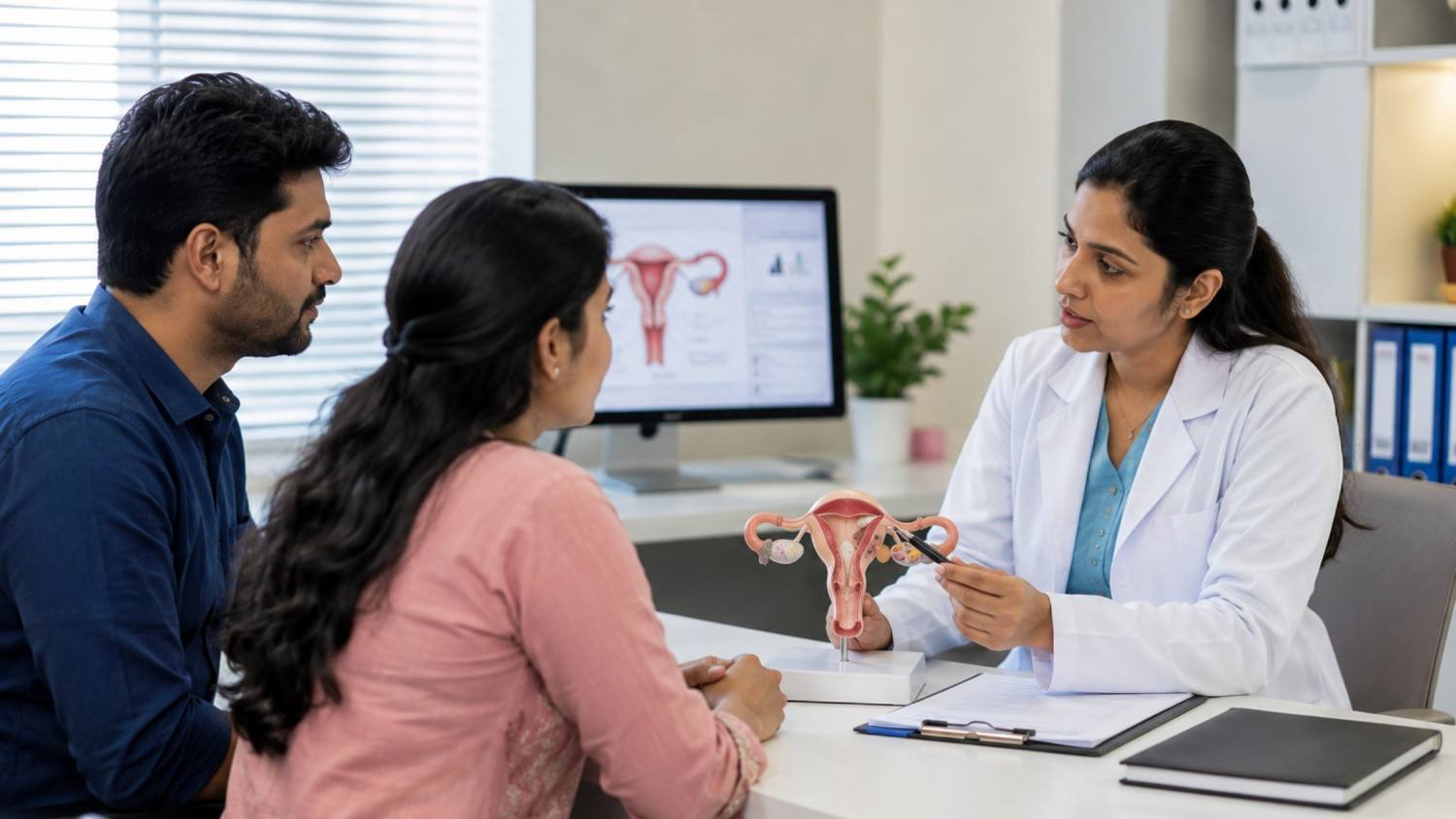
Your reports are back, somebody has used the word IVF, and the number attached to it made your stomach drop. Before you agree to anything, it’s worth knowing that fertility treatment in Bangalore covers a wide ladder of options, and IVF sits near the top of it rather than at the start. Shanbhag Hospital provides a hospital-based setting for couples seeking fertility evaluation, specialist consultation and treatment guidance. If you are considering Shanbhag Hospital for fertility treatment in Bangalore, understanding how different treatment options match different causes can help you approach the process with greater clarity.
Matching Fertility Treatment in Bangalore to the Cause
Every sensible plan for fertility treatment in Bangalore starts from a diagnosis. Ovulation problems respond to tablets. Damaged tubes don’t, and no amount of ovulation induction will change that. Poor sperm quality may need ICSI or a urology opinion. A polyp sitting in the cavity needs removing before an embryo has a fair chance.
The mistake couples make most often is buying a treatment before establishing which of these applies. If a plan is proposed at your first fertility consultation in Bangalore without a semen analysis and tubal test in hand, ask what it’s based on.
Starting Simple: Lifestyle and Ovulation Induction
The things that genuinely move the needle
Not much in the lifestyle column changes outcomes dramatically, but a few things do. Weight loss of five to ten percent frequently restores ovulation in women with PCOS. Stopping smoking helps both partners. Reducing heavy alcohol intake, controlling thyroid disease and managing insulin resistance all matter measurably. Sleep and stress matter less than the internet suggests, though shift work that wrecks both is worth discussing honestly.
These changes take three to six months to show any effect, which is why they run alongside medical assessment rather than replacing it. If the female partner is over 35, don’t spend a year on lifestyle alone.
Ovulation induction
For women who aren’t ovulating reliably, oral medication taken early in the cycle prompts follicle development, tracked by two or three short scans. Cycles are usually attempted for three to six months before reassessing. It’s the cheapest and least disruptive form of fertility treatment in Bangalore, and for PCOS it’s often all that’s needed.
IUI: Who It Suits, and Who It Doesn’t
Intrauterine insemination places washed, concentrated sperm directly into the uterus around ovulation. The procedure takes minutes, needs no anaesthesia, and you walk out afterwards.
Where it works well:
• Mild male-factor problems with reasonable total motile counts
• Unexplained infertility in a woman under 35
• Cervical factor, or difficulty timing intercourse because of travel or shift work
Where it doesn’t:
• Blocked or badly damaged tubes
• Very low sperm counts, where ICSI is the sensible route
• Significant endometriosis
Three to four attempts is the usual fair trial. Beyond that the odds don’t improve much, and continuing is often an expensive way to delay a decision.
IVF and ICSI: What the Cycle Involves
Stimulation
Ten to fourteen days of daily injections encourage multiple follicles to develop, monitored by scans every two or three days. Most people manage the injections themselves at home after being shown how. This is the phase that demands early-morning clinic visits, which is worth remembering when you pick a fertility clinic in Bangalore relative to where you live.
Retrieval, lab and transfer
Egg collection is done under short sedation and takes around twenty minutes. Eggs are fertilised in the lab, either conventionally or by ICSI, where a single sperm is injected into each egg for male-factor cases. Embryos are grown for three to five days, then one is transferred, with any surplus frozen. A pregnancy test follows about two weeks later.
Success rates fall with the female partner’s age, sharply after 38. Any fertility specialist in Bangalore quoting a single headline figure without asking your age isn’t giving you usable information.
Where Surgery Fits Into Infertility Treatment in Bangalore
Surgery is underrated in conversations about infertility treatment in Bangalore, partly because it’s less profitable than IVF. Hysteroscopy removes polyps, submucous fibroids and intrauterine adhesions, usually as a day-care procedure. Laparoscopy treats endometriosis and releases adhesions, and can help both natural conception and later IVF outcomes.
Recovery is generally quick, a few days for hysteroscopy and one to two weeks for laparoscopy. Where a structural problem is clearly present, correcting it first often improves whatever comes next.
Comparing Fertility Treatment in Bangalore: Cost and Time
Costs for fertility treatment in Bangalore shift with drug doses, brands and add-ons, so treat the figures below as indicative and ask for a written breakdown before committing.
| Option | Time per cycle | Indicative cost | Physical demand | Usual number of attempts |
| Ovulation induction | One cycle, 2–3 scans | Low thousands | Minimal | 3–6 |
| IUI | One cycle, 3–4 visits | Fifteen to thirty thousand | Low | 3–4 |
| IVF / ICSI | 4–6 weeks | Low lakhs upward | Moderate to high | 1–3 |
| Hysteroscopy | Day care | Tens of thousands | Low | Usually once |
| Laparoscopy | Day care or overnight | Higher than hysteroscopy | Moderate | Usually once |
Medication is the most variable line item in any of these, and the one that most often exceeds what people expected.
Choosing a Fertility Clinic in Bangalore
Clinics offering assisted reproduction in India must be registered under national ART regulations, and you’re entitled to see that registration. Beyond it, a handful of questions separate good units from ordinary ones:
• Who performs the procedures, and will you see the same fertility specialist in Bangalore each visit?
• Is the embryology lab on site, or is the work outsourced?
• What are the earliest scan slots, and how are urgent changes communicated?
• How many attempts do you recommend before changing your approach?
• What are the storage terms and annual charges for frozen embryos?
• Is counselling available, and is it included?
Location deserves more weight than couples give it. Monitored cycles mean repeat visits at short notice, often before work, and Bangalore traffic punishes optimistic planning. Reproductive care in Bangalore that’s twenty minutes from home usually beats a marginally better-reviewed unit an hour away, because cycles get cancelled when scans get missed.
Knowing When to Change Course
Every course of fertility treatment in Bangalore should come with a stopping rule agreed in advance. Three or four IUI cycles, three to six induction cycles, a defined number of IVF attempts before reviewing the whole approach. Without that, it’s easy to spend two years and a great deal of money repeating something that isn’t working.
Reassess if two things happen: the treatment fails its agreed number of attempts, or your circumstances change, particularly age. Booking a second fertility consultation in Bangalore elsewhere is normal and reasonable, and no good clinician takes offence at it.
Why Choose Shanbhag Hospital for Fertility Treatment in Bangalore?
Choosing a fertility hospital involves more than comparing treatment names or advertised packages. Shanbhag Hospital provides a hospital-based setting where couples can seek fertility consultation, diagnostic evaluation and specialist guidance based on their individual circumstances. A coordinated hospital environment can be helpful when fertility concerns involve both partners or require support from different medical specialties. Clear communication about diagnosis, treatment choices, expected timelines and costs can also help couples make informed decisions before proceeding with treatment.
Frequently Asked Questions
How do we know which fertility treatment in Bangalore is right for us?
It follows from the diagnosis. Anovulation points to ovulation induction, mild male factor or unexplained infertility to IUI, blocked tubes or severe male factor to IVF and ICSI, and structural problems to corrective surgery. Age and ovarian reserve determine how quickly you should move up the ladder.
Is IVF always more successful than IUI?
Per cycle, generally yes, but that comparison misleads. IUI costs a fraction as much and suits particular diagnoses well. For an ovulating 29-year-old with open tubes and a mildly low sperm count, starting with IUI is reasonable. For a 40-year-old with low reserve, going straight to IVF usually is.
How long does a full treatment cycle take?
An induction or IUI cycle fits inside one menstrual cycle. IVF runs roughly four to six weeks from the first injection to the pregnancy test, with more frequent monitoring in the middle. Add a few weeks beforehand for testing, and allow gaps between cycles.
Does insurance cover fertility treatment in Bangalore?
Frequently not, or only partially. Many Indian policies exclude assisted reproduction while still covering diagnostic tests, related surgery such as laparoscopy, and pregnancy complications afterwards. Check your policy wording, and ask the billing desk at your fertility clinic in Bangalore what they’ve seen approved recently.
Conclusion
Fertility treatment in Bangalore works best approached as a ladder rather than a leap. Establish the diagnosis, start at the lowest rung that fits it, agree how many attempts you’ll make, and move up when the evidence says to. Some couples never need more than tablets and a few scans. Others should go straight to IVF, and delaying reproductive care in Bangalore costs them time they can’t get back. Knowing which of those describes you is what the testing phase is for. Shanbhag Hospital can provide hospital-based support for couples seeking fertility evaluation, specialist guidance and appropriate treatment options.
This article is general information and not a substitute for medical advice; please consult a qualified doctor about your own situation. If you’re weighing up options, Shanbhag Hospital can help you take the next step with an appropriate fertility consultation and treatment plan. Contact Shanbhag Hospital today to discuss your fertility concerns and schedule a consultation. Follow Shanbhag Hospital on Instagram for fertility information, health updates and practical guidance for couples exploring fertility treatment.