Most couples don’t walk into a clinic after one difficult month. They wait. A year passes, relatives start asking questions, and one evening somebody finally types “fertility care in Basaveshwaranagar” into a phone at 11pm. If that sounds familiar, you’re in ordinary company, and probably further along in your thinking than you credit yourself for. Shanbhag Hospital provides fertility consultations and specialist support for couples exploring their reproductive health options. If you are considering Shanbhag Hospital for fertility care in Basaveshwaranagar, understanding the assessment and treatment process can help you approach the next step with greater clarity.
This guide covers what actually happens when you seek help: which tests come first, why your cycle dates matter for booking, what the main treatment routes involve, and roughly what each stage costs. No promises about outcomes, because nobody honestly makes those. Just a clear map of the road ahead.
When It’s Worth Seeing a Fertility Specialist in Basaveshwaranagar
The usual guidance is straightforward. If the female partner is under 35 and you’ve been trying for 12 months without conceiving, it’s reasonable to get assessed. If she’s 35 or older, that window shortens to about six months, because egg number and quality decline faster after the mid-thirties.
Some situations justify starting fertility care in Basaveshwaranagar earlier, without waiting out any clock:
- Periods that are absent, wildly irregular, or more than 35 days apart
- A known diagnosis such as PCOS, endometriosis, thyroid disease or fibroids
- Previous pelvic surgery or a past pelvic infection
- Two or more pregnancy losses
- A male partner with testicular injury, undescended testis, or prior chemotherapy
- Anything that makes intercourse painful
Booking a fertility consultation in Basaveshwaranagar early isn’t dramatic. It’s often reassuring, because a good proportion of couples turn out to have a simple, treatable issue like an ovulation problem, and the sooner that’s found the shorter the journey gets. Nobody will push you into treatment at a first fertility consultation in Basaveshwaranagar.
What Fertility Care in Basaveshwaranagar Usually Starts With
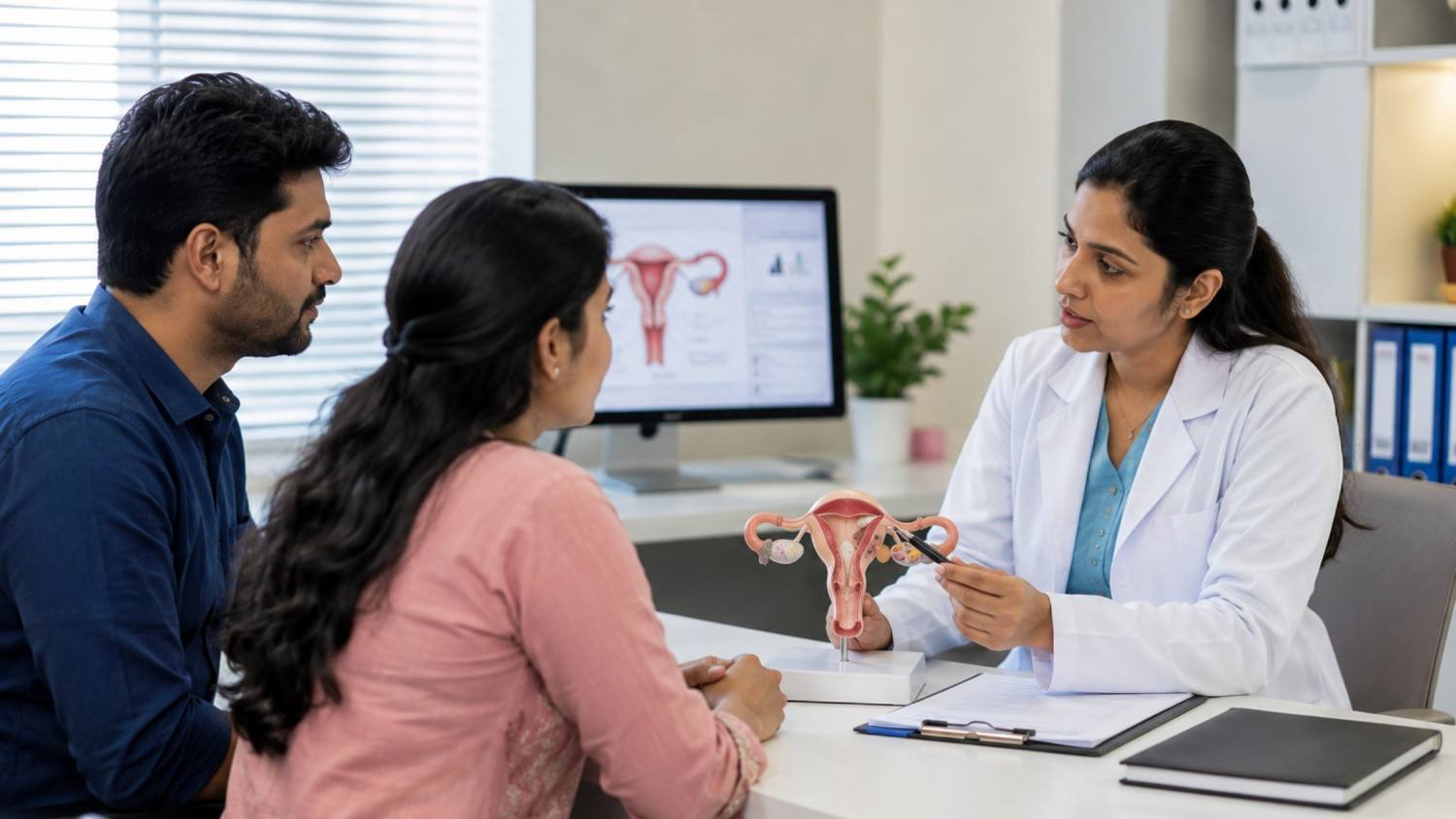
Fertility care in Basaveshwaranagar begins with conversation rather than needles. Expect questions about cycle length, period pain, previous pregnancies, how long you’ve been trying, medications, surgeries, weight changes and work patterns. Bring both partners. A frequent mistake is the woman attending three appointments alone before anyone tests the male partner, and a large share of cases involve a male factor.
For the female partner
Baseline blood work is usually drawn on day 2 or day 3 of your period, so the clinic will ask you to call when your cycle starts rather than book a fixed date. Typical tests include AMH (a marker of ovarian reserve), FSH, LH, thyroid function, prolactin and blood sugar markers if PCOS is suspected. A transvaginal ultrasound counts antral follicles and checks the uterus for fibroids or polyps. Tubal patency is checked separately, by HSG or a saline sonosalpingogram, in the first half of the cycle.
For the male partner
A semen analysis is the most useful test and the one most often delayed. It needs two to five days of abstinence beforehand, and a fertility doctor in Basaveshwaranagar will read it alongside a physical examination. One abnormal report isn’t a verdict; counts fluctuate with fever, illness and heat exposure, so a repeat after six to twelve weeks is standard.
Reading Your Results Without Panicking
Numbers on a fertility report are probabilities, not sentences. A low AMH suggests how many eggs are likely to respond to stimulation. It says little about whether you can conceive naturally this year. A normal AMH in a 40-year-old doesn’t reset the clock on egg quality either.
The same applies to semen analysis. Slightly low motility with a good total count is a different problem from a near-absent count, and the two lead to different plans. Ask your fertility doctor in Basaveshwaranagar what each result changes about your options, rather than what it means in isolation. That one question turns an intimidating printout into something you can act on.
Core Fertility Treatment Services in Basaveshwaranagar
Good reproductive care in Basaveshwaranagar follows a structured approach. Treatment should match the underlying cause, beginning with appropriate evaluation and moving to the least complex option that fits the diagnosis. Shanbhag Hospital’s core fertility services can include fertility workups, ovulation induction, IUI and reproductive surgery based on individual needs.
| Approach | Typically suits | What’s involved | Usual trial |
| Fertility workup | Couples with difficulty conceiving or specific reproductive concerns | Medical history, blood tests, ultrasound, semen analysis and tubal assessment where required | Based on findings |
| Ovulation induction | PCOS, anovulation and selected ovulatory disorders | Oral medication, follicle monitoring and timed ovulation | 3–6 cycles |
| IUI | Mild male factor, unexplained fertility issues and selected cervical factors | Washed sperm placed in the uterus around ovulation | 3–4 cycles |
| Reproductive surgery | Fibroids, polyps, endometriosis, septum and selected structural problems | Hysteroscopy or laparoscopy, depending on the condition | Usually one-off |
Fertility Workups
A fertility workup is the starting point when the cause of difficulty conceiving is unclear. Assessment generally considers both partners rather than focusing on the female partner alone. Depending on the history, this can involve hormone testing, ultrasound, semen analysis and assessment of whether the fallopian tubes are open.
The purpose is straightforward: identify whether ovulation, sperm factors, the uterus, fallopian tubes or another reproductive factor may be affecting conception. Once the results are available, the fertility specialist can recommend the most appropriate next step.
Ovulation Induction
Ovulation induction is commonly considered when ovulation is irregular or absent, including in some women with PCOS. Medication is used to encourage ovulation, with ultrasound monitoring helping the specialist track follicle development and determine appropriate timing.
These are generally outpatient treatment cycles, but they require monitoring. You may need several short scan visits during a cycle to track follicle growth and determine when ovulation is likely to occur. Choosing a fertility service in Basaveshwaranagar that is convenient for regular monitoring can make the process easier to manage.
IUI
Intrauterine insemination, or IUI, involves preparing a semen sample and placing the processed sperm directly into the uterus around the time of ovulation. It may be considered for selected cases of mild male-factor fertility problems, unexplained infertility or cervical factors.
The timing of IUI is important, so follicle monitoring may be used to determine the appropriate treatment window. The fertility specialist will assess the couple’s test results and reproductive history before deciding whether IUI is suitable.
Reproductive Surgery
Some fertility problems are related to structural conditions affecting the uterus, fallopian tubes or pelvis. Fibroids, endometrial polyps, endometriosis and uterine septum are examples where reproductive surgery may be considered.
Depending on the condition, treatment may involve hysteroscopy or laparoscopy. The aim is to address the identified structural problem and improve the reproductive environment where appropriate. The specialist will explain whether surgery is necessary, what it involves and what follow-up is required.
What Fertility Treatment in Basaveshwaranagar Costs
Costs for fertility treatment in Basaveshwaranagar move with the tests required, medication doses, scan numbers and whether a procedure is needed, so treat any figures as indicative rather than a quote. A first consultation with basic blood tests commonly lands in the low thousands of rupees. A full workup for both partners, including appropriate imaging, can run into the mid five figures. An IUI cycle with medication and monitoring typically sits between fifteen and thirty thousand rupees, while reproductive surgery varies substantially depending on the condition and procedure involved.
Ask for a written breakdown separating consultation, medicines, laboratory charges, imaging and procedure-related costs. This makes it easier to understand what is included and what additional expenses may arise during treatment.
Choosing a Clinic for Fertility Care in Basaveshwaranagar
Basaveshwaranagar provides convenient access for many families in west Bangalore. That matters more than it sounds. Monitored fertility treatment can require repeat visits at short notice, and a long commute can become difficult when appointments need to fit around work and daily responsibilities.
Practical things worth asking before you commit:
- Is the fertility unit equipped to complete the required diagnostic workup?
- Will you see the same consultant each visit?
- Can you get early-morning scan slots before work?
- Are semen analysis, ultrasound and other relevant investigations available through the hospital?
- Are reproductive surgical procedures available when a structural fertility problem is identified?
- How are treatment plans and follow-up communicated between visits?
Fertility care in Basaveshwaranagar carries an emotional cost clinics don’t always discuss. Two-week waits and repeated appointments can be hard. Tell one or two people you trust, and ask whether counselling support is available if you feel you need it.
Why Choose Shanbhag Hospital for Fertility Care in Basaveshwaranagar?
Choosing a fertility care provider involves more than looking at treatment options or appointment availability. Shanbhag Hospital provides a hospital-based setting where patients can seek fertility consultations, appropriate evaluation and specialist guidance based on their individual circumstances. A structured approach to assessment can help couples understand which tests may be relevant before moving towards treatment. Depending on the diagnosis, care may include fertility workups, ovulation induction, IUI or reproductive surgery. Clear communication about available options, expected steps and follow-up can also help couples make informed decisions throughout their fertility journey.
Frequently Asked Questions
How long should we try before seeking fertility care in Basaveshwaranagar?
Twelve months of regular unprotected intercourse if the female partner is under 35, and about six months if she’s 35 or older. See a fertility doctor in Basaveshwaranagar sooner if periods are irregular or absent, if there’s known endometriosis or PCOS, or after pelvic surgery, chemotherapy or repeated pregnancy loss.
Do both partners need testing at the first visit?
Yes, ideally. Male factor contributes to a large share of cases and semen analysis is quick, inexpensive and non-invasive. Testing only the woman first is the commonest reason couples lose three or four months. A fertility specialist in Basaveshwaranagar will normally request both sets of tests together.
What fertility treatments are available besides medication?
Treatment depends on the cause identified during the fertility workup. Depending on the findings, options can include ovulation induction, IUI or reproductive surgery. The appropriate route should be decided after evaluating both partners and identifying the factors affecting conception.
When is IUI considered?
IUI may be considered in selected cases involving mild male-factor fertility problems, unexplained fertility issues or certain cervical factors. The fertility specialist will review the test results, ovulation pattern and other relevant factors before recommending it.
When might reproductive surgery be needed?
Reproductive surgery may be considered when structural conditions such as fibroids, polyps, endometriosis or a uterine septum are affecting fertility. Depending on the condition, hysteroscopy or laparoscopy may be recommended.
Can lifestyle changes genuinely make a difference?
They can, particularly where weight, insulin resistance, smoking or heavy alcohol use is involved. Modest weight loss can improve ovulation in some women with PCOS. Changes work slowly, though, so run them alongside medical assessment rather than instead of it, especially if the female partner is over 35.
Conclusion
Fertility care in Basaveshwaranagar is less mysterious than it looks from outside. A structured assessment of both partners, honest reading of the results, and a treatment plan based on the underlying cause will answer many of the questions keeping you awake. Some couples may need only targeted treatment for an ovulation problem, while others may benefit from IUI or reproductive surgery to address an identified fertility issue. The important first step is a proper workup rather than continuing to wait without understanding the cause. Shanbhag Hospital can provide specialist support for couples seeking appropriate fertility evaluation and guidance.
This article is general information and not a substitute for medical advice; please consult a qualified doctor about your own situation. If you’re unsure where to begin, Shanbhag Hospital can help you take the next step with an appropriate fertility consultation. Contact Shanbhag Hospital today to discuss your fertility concerns and schedule a consultation with the appropriate specialist. Follow Shanbhag Hospital on Instagram for fertility information, health updates and practical guidance for couples exploring reproductive care.