The hardest part is rarely the treatment. It’s not known. You’ve been trying for a year, every month follows the same arc of hope and disappointment, and nobody has told you plainly what’s going on. A fertility hospital in Basaveshwar Nagar can help bring structure to that uncertainty, starting with a proper diagnosis. Shanbhag Hospital provides a hospital-based setting for couples seeking fertility evaluation, specialist consultation and treatment guidance. Choosing Shanbhag Hospital as a fertility hospital in Basaveshwar Nagar can also give couples access to coordinated medical support as they move through assessment and treatment.
This guide sets out the sequence: what a first appointment covers, which tests get ordered and when, how results translate into a plan, and what the different treatment routes ask of you in time and money. It’s written for couples deciding whether to make the call, not for people already halfway through a cycle.
When to See a Fertility Specialist in Basaveshwar Nagar
Not everyone who worries needs treatment, and no reasonable fertility specialist in Basaveshwar Nagar will suggest otherwise. The standard threshold is 12 months of regular, unprotected intercourse without conception if the female partner is under 35, and six months if she’s 35 or older. Below those thresholds, most couples simply need more time.
There are exceptions where waiting is the wrong call. Absent or highly irregular periods point to an ovulation problem that won’t fix itself. Known endometriosis, PCOS or fibroids change the calculation. So does previous pelvic surgery, a history of pelvic infection, two or more miscarriages, or a male partner with a testicular injury, an undescended testis in childhood, or past cancer treatment. In those cases, book a fertility consultation in Basaveshwar Nagar without watching the calendar.
What a Fertility Hospital in Basaveshwar Nagar Can Offer
A hospital-based fertility centre spans more than an IVF lab. A fertility hospital in Basaveshwar Nagar may provide diagnostic evaluation, ovulation induction, IUI, assisted reproduction, corrective surgery and obstetric care after a successful pregnancy.
| Service | What it addresses | Typical setting |
| Diagnostic workup | Hormones, ovarian reserve, tubes, uterus, semen quality | Outpatient, across 2–6 weeks |
| Ovulation induction | PCOS and other anovulatory cycles | Outpatient, tablets plus scans |
| IUI | Mild male factor, unexplained infertility | Day procedure, no anaesthesia |
| IVF and ICSI | Blocked tubes, severe male factor, low ovarian reserve | Injections, retrieval under sedation |
| Hysteroscopy / laparoscopy | Polyps, fibroids, adhesions, endometriosis | Day-care or one-night stay |
| Male fertility input | Varicocele, hormonal causes, sperm retrieval | Urology, coordinated with the same team |
The practical advantage of a multispeciality hospital is that thyroid disease, diabetes, obesity and male-factor problems can be handled by colleagues within the same hospital rather than through referral letters across the city. That’s a large part of why couples consider hospital-basedreproductive care in Basaveshwar Nagar.
The Diagnostic Pathway, Step by Step
The First Fertility Consultation in Basaveshwar Nagar
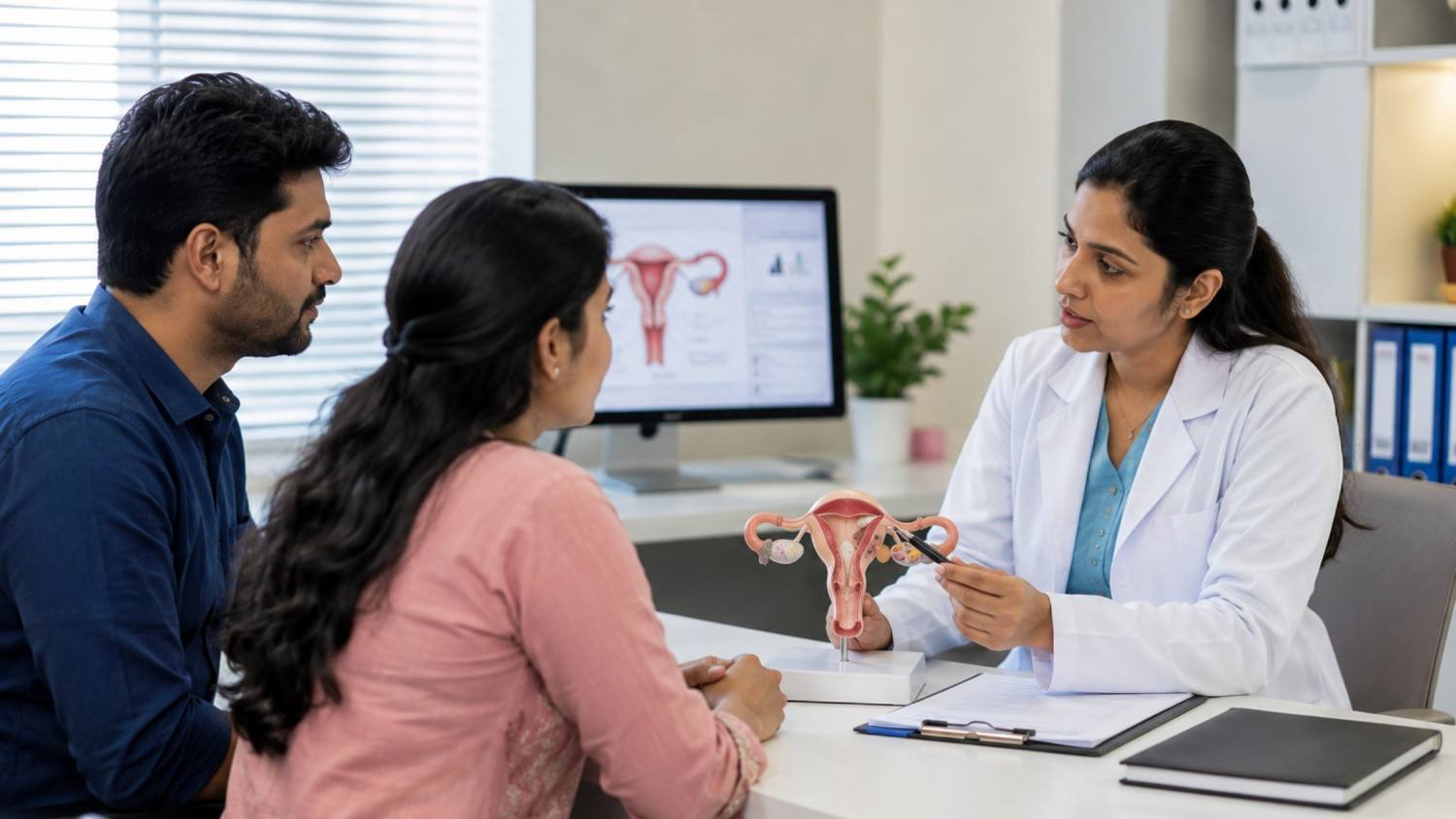
Expect an hour of history-taking rather than a scan. Cycle length, period pain and flow, previous pregnancies or losses, surgeries, medications, thyroid symptoms, weight change, smoking, and how often you’re actually able to have intercourse given shift work and travel. Both partners should attend. If only one of you can make it, don’t let it be the male partner, because his test is the fastest to complete.
The Testing Block
Female testing is cycle-linked, which is why it takes weeks. Day 2 or 3 blood tests measure FSH, LH and often AMH; thyroid and prolactin can be done any day; a progesterone level about a week before the expected period confirms ovulation happened. Ultrasound assesses antral follicle count, uterine lining and any fibroid or polyp. Tubal testing by HSG or saline sonosalpingography is scheduled after bleeding stops and before ovulation.
Male testing is a single semen analysis with two to five days of abstinence, repeated after six to twelve weeks if the first is abnormal. A fertility doctor in Basaveshwar Nagar will usually want that repeat before recommending anything invasive.
What the Results Change
A diagnosis matters only insofar as it changes the plan. Apply that lens when your fertility specialist in Basaveshwar Nagar walks you through the reports.
- Anovulation, usually PCOS: ovulation induction is the first step, often with weight and insulin management alongside
- Blocked tubes: IUI is off the table; IVF or, occasionally, tubal surgery is the route
- Low ovarian reserve: the plan moves faster, with less time spent on gentler options
- Severe male factor: ICSI, sometimes with surgical sperm retrieval and a urology opinion
- Endometriosis or submucous fibroid: surgical correction may be needed before anything else
- Unexplained infertility, roughly one case in five: a timed trial of induction and IUI before escalating
Unexplained results frustrate people more than bad ones. It doesn’t mean nothing is wrong, only that current tests can’t see it. Many of those couples still conceive with treatment.
Infertility Treatment in Basaveshwar Nagar: The Realistic Sequence
Reasonable infertility treatment in Basaveshwar Nagar starts simple. Three to six cycles of ovulation induction suit anovulatory patients under 35. IUI usually gets three or four attempts before it’s fair to call it. IVF is the step up, and it isn’t a last resort so much as the right first step for blocked tubes, very low sperm counts, or a woman over 38 with reduced reserve.
Each rung has a stopping rule. If your fertility doctor in Basaveshwar Nagar can’t tell you how many attempts they’d recommend before changing tack, ask. Open-ended repetition of a treatment that isn’t working is the most expensive mistake in this field.
Costs and Timelines at a Fertility Hospital in Basaveshwar Nagar
Figures depend heavily on drug doses and add-ons, so treat these as indicative ranges, not quotes. A first consultation with baseline bloods usually costs a few thousand rupees. A full workup across both partners, imaging included, commonly reaches the mid five figures. An IUI cycle with monitoring and medication typically falls in the fifteen to thirty thousand range. IVF with medication generally starts in the low lakhs per cycle and rises with higher doses, ICSI, freezing and genetic testing.
Time matters as much as money when choosing a fertility hospital in Basaveshwar Nagar. A diagnostic block runs two to six weeks. An induction or IUI cycle is one menstrual cycle with three or four early-morning visits. An IVF cycle takes roughly four to six weeks from the start of injections to a pregnancy test, with more frequent monitoring in the middle fortnight.
Choosing a Fertility Hospital in Basaveshwar Nagar
Basaveshwar Nagar is convenient for Vijayanagar, Rajajinagar, Nagarbhavi, Kamakshipalya and Yeshwanthpur, which is worth weighing seriously. Monitored cycles need visits at short notice, often at 7am, and west Bangalore traffic turns a short hop into an hour. Choosing a fertility hospital in Basaveshwar Nagar over a clinic across the city can therefore be a practical decision as much as a convenience one, because missed scans can mean cancelled cycles.
Three habits are worth building early:
- Keep every report in one dated folder, digital and physical; your fertility hospital and specialist team will ask for old results constantly.
- Agree between yourselves how many cycles you’ll attempt before pausing to reassess.
- Ask for the earliest morning slots, so monitoring scans don’t collide with work.
Why Choose Shanbhag Hospital for Fertility Care in Basaveshwar Nagar?
Choosing a fertility hospital involves more than looking at treatment options alone. Shanbhag Hospital provides a hospital-based setting where couples can seek fertility consultation, diagnostic evaluation and specialist guidance based on their individual circumstances. A coordinated hospital environment can be useful when fertility concerns involve both partners or require support from areas such as gynaecology, urology, endocrinology or other medical departments. Clear communication about investigations, treatment options, costs and follow-up can also help couples make informed decisions throughout their fertility journey.
Frequently Asked Questions
How soon can we start treatment after our first visit?
Rarely the same month. Female testing is tied to specific cycle days, so the diagnostic block usually takes two to six weeks. Once results are in, treatment often begins with the next period. A fertility hospital in Basaveshwar Nagar can move faster if earlier reports are available, so carry them.
Does my husband really need to be tested if he’s healthy?
Yes. Male factor contributes to a substantial share of cases and produces no symptoms at all. Semen analysis is quick, inexpensive and non-invasive, and skipping it is the single most common reason couples lose several months before anyone finds the real problem.
Is IVF the only option for blocked fallopian tubes?
Usually, though not always. If the blockage is minor and near the uterus, or caused by adhesions a laparoscopy can release, surgery is sometimes reasonable. With badly damaged or fluid-filled tubes, IVF bypasses the problem and is generally the better use of your time and money.
Can we get everything done at one hospital?
Often yes. A fertility hospital in Basaveshwar Nagar within a multispeciality hospital can combine gynaecology, urology, endocrinology, anaesthesia and obstetric follow-up, so thyroid or diabetes management and male-factor assessment happen without separate referrals. Ask specifically whether the embryology lab is on site, since that’s the one component some units outsource.
Conclusion
Diagnosis first, then treatment, in that order. That’s the whole logic behind how a fertility hospital in Basaveshwar Nagar should approach fertility care, and it’s why the early weeks feel slow. Once you know whether the issue is ovulation, tubes, sperm quality, the uterus, or genuinely unexplained, the choices narrow to two or three sensible options, and the guesswork stops. Most couples find the plan less frightening than the uncertainty that came before it. Shanbhag Hospital can provide a hospital-based setting for couples seeking fertility evaluation, specialist guidance and appropriate treatment options.
This article is general information and not a substitute for medical advice; please consult a qualified doctor about your own circumstances. If you’re not sure what your next step should be, an initial review with an experienced local fertility team can give you answers that match your situation. Shanbhag Hospital can help you take the next step with an appropriate fertility consultation. Contact Shanbhag Hospital today to discuss your fertility concerns and schedule a consultation.Follow Shanbhag Hospital on Instagram for fertility information, health updates and practical guidance for couples exploring reproductive care.