Back pain is one of those conditions that feels both ordinary and extraordinary. Almost everyone has had a stiff back at some point — after a long flight, a heavy workout, or a bad night’s sleep. But for many, what starts as occasional discomfort gradually becomes a daily companion. They try home remedies, over-the-counter painkillers, hot packs, yoga videos, and finally a chiropractor or two — and only when nothing works do they search for a back pain specialist near me.By then, weeks or months have often gone by, and the underlying cause has had time to worsen.
This guide is meant to change that pattern. We’ll walk through what causes back pain, when it stops being routine, what specialists actually do, and what modern treatment looks like — from physiotherapy to injections to spine surgery, with everything in between.
Why Back Pain Is So Common
Your spine isn’t just a single rod — it’s a complex structure of 33 bones (vertebrae), discs that cushion them, dozens of joints, ligaments, muscles, and nerves running through tight bony channels. The lumbar (lower) and cervical (neck) regions take the most stress. Combine that with modern lifestyles — long hours at a desk, poor posture, weight gain, weak core muscles, and minimal physical activity — and it’s no surprise that back pain affects most adults at some point.
The Cleveland Clinic resource on back pain provides excellent background reading on causes and patterns.
Common Causes of Back Pain
| Cause | What’s Happening |
| Muscle strain | Overstretched or torn back muscles |
| Herniated / slipped disc | Disc material pushes onto nearby nerves |
| Spinal stenosis | Narrowing of the spinal canal compressing nerves |
| Spondylolisthesis | One vertebra slipping over another |
| Osteoarthritis | Wear-and-tear of spinal joints |
| Spondylitis | Inflammation of vertebral joints |
| Osteoporosis | Weak bones leading to fractures or compression |
| Sciatica | Pain radiating from the back down the leg |
| Sacroiliac joint dysfunction | Pain at the base of the spine and buttocks |
| Infections, tumours | Rare but important causes |
Symptoms That Warrant Seeing a Specialist
Most back pain settles within a few weeks. But you should consult a back pain specialist if:
• Pain lasts longer than 4–6 weeks
• Pain radiates down one or both legs (sciatica)
• You feel numbness, tingling, or weakness in the legs
• The pain is severe at night or wakes you up
• You’re losing weight unexpectedly
• There’s loss of bladder or bowel control (urgent — emergency)
• Pain followed an injury or fall
• Walking distance is decreasing
• Pain is interfering with sleep, work, or daily activity
The MedlinePlus resource on back pain emphasises that persistent or “red flag” symptoms always need professional evaluation.
What a Back Pain Specialist Actually Does
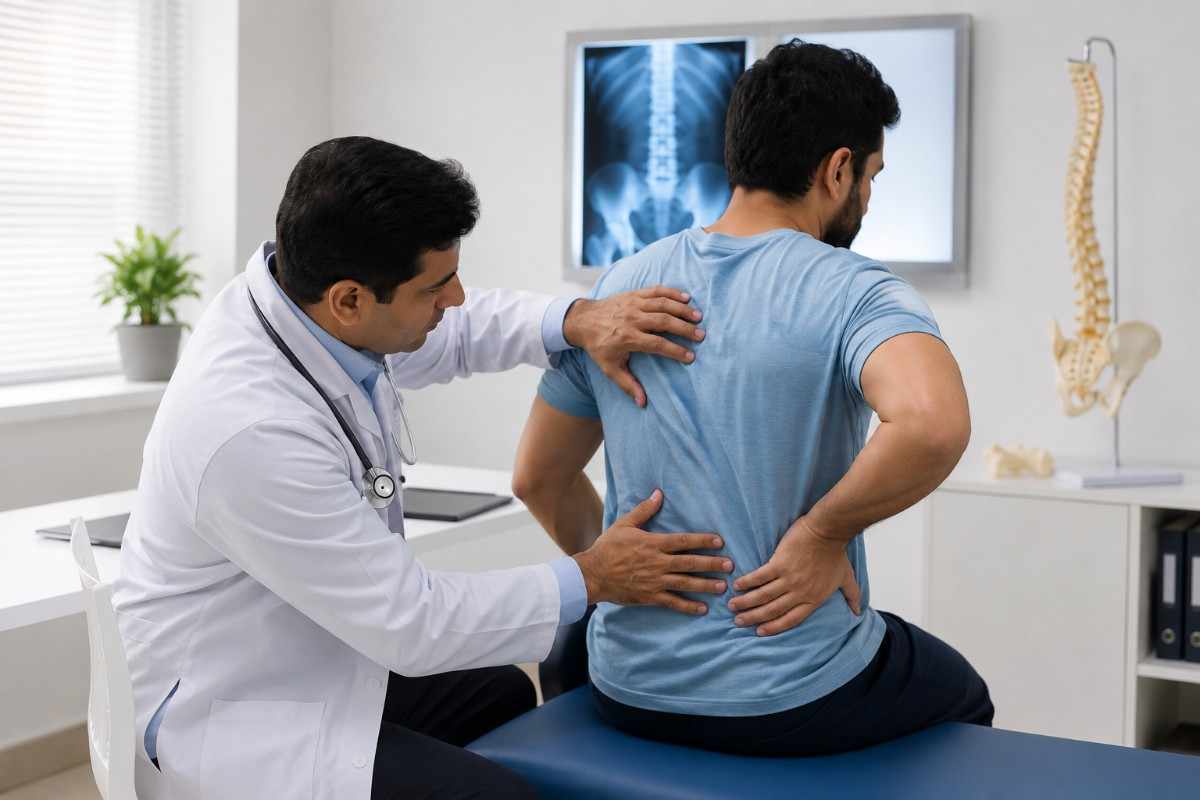
The first visit is usually about understanding the pattern of pain — not just the location. A thorough specialist:
1. Takes a detailed history — onset, triggers, radiation, duration, sleep impact
2. Performs a physical and neurological examination
3. Tests reflexes, muscle strength, sensation
4. Identifies red flags or simple muscle-related causes
5. Orders imaging only if clinically warranted
6. Recommends a step-wise treatment plan
A good specialist doesn’t rush you into MRI or injections on day one. They first identify whether the cause is muscular, structural, or neurological — then decide accordingly.
Diagnostic Tests for Back Pain
When indicated:
• X-ray spine — for bone alignment, fractures
• MRI spine — gold standard for discs, nerves, soft tissues
• CT scan — useful for complex bony pathology
• DEXA scan — for bone density (osteoporosis)
• Blood tests — to rule out infection, inflammation, vitamin D deficiency
• EMG / Nerve conduction studies — for nerve compression assessment
Treatment Options: A Stepwise Approach
Modern back pain care follows a logical progression — least invasive first, surgery only when truly needed.
Step 1: Conservative Management (covers most patients)
• Rest and activity modification (short-term only)
• Physiotherapy — the most underrated, most effective treatment
• Targeted core and back-strengthening exercises
• Posture correction
• Ergonomic changes at work
• Hot/cold packs
• Anti-inflammatory medication
• Muscle relaxants if needed
• Weight management
• Stress and sleep optimisation
Step 2: Interventional Pain Management
For pain not settling with physiotherapy:
• Epidural steroid injections — for nerve root inflammation
• Facet joint injections — for facet joint arthritis
• Sacroiliac joint injections — for SI joint dysfunction
• Radiofrequency ablation — for chronic facet pain
These are minimally invasive procedures with quick recovery.
Step 3: Surgical Treatment (selected cases)
When structural problems aren’t responding to conservative care:
• Microdiscectomy — for disc herniation pressing on nerves
• Laminectomy — for spinal stenosis
• Spinal fusion — for instability
• Disc replacement — modern alternative in selected cases
• Minimally invasive spine surgery — small incisions, faster recovery
Spine surgery is a last resort — but when needed, modern techniques have made it dramatically safer and faster.
The Mayo Clinic guide to back pain treatment provides further details.
Slipped Disc and Sciatica: The Most Common Specific Diagnoses
A herniated (slipped) disc happens when the soft inner core of a spinal disc bulges out and presses on a nerve. The classic symptom is sharp pain travelling down the buttock, thigh, and leg — known as sciatica.
Most slipped discs improve with:
• 4–6 weeks of physiotherapy
• Anti-inflammatory medication
• Posture and core strengthening
Surgery is reserved for cases where:
• Pain remains severe after 6 weeks
• Significant leg weakness develops
• Bowel/bladder symptoms appear
Physiotherapy: The Most Important Tool in Back Pain
Patients often want a “quick fix,” but physiotherapy genuinely outperforms most short-term solutions. A structured 4–6 week programme can:
• Strengthen weak core and back muscles
• Improve posture and body mechanics
• Reduce nerve compression through specific exercises
• Prevent future episodes
A great back pain specialist always pairs medical or surgical treatment with high-quality physiotherapy.
When Back Pain Becomes a Medical Emergency
Seek immediate care if you experience:
• Loss of bladder or bowel control
• Severe weakness or numbness in legs
• Saddle anaesthesia (numbness around the genitals)
• Severe back pain after major trauma
• Fever with back pain
• Sudden onset of severe pain in elderly osteoporotic patients
These can indicate cauda equina syndrome, spinal infection, or vertebral fracture — all needing urgent attention.
Why Choose Ananya Hospitals for Back Pain Care
Ananya Hospitals is recognised in Bengaluru for evidence-based, conservative-first back pain management. Patients across Karnataka choose us because:
• Senior orthopaedic and spine specialists
• In-house physiotherapy team with structured rehabilitation plans
• Modern MRI and digital X-ray facilities
• Pain management specialists for injection-based treatments
• Minimally invasive spine surgery when truly needed
• Honest, conservative approach — surgery is recommended only when justified
• Transparent, written treatment plans
• Cashless insurance support
Our orthopedics department is structured around long-term spine health — not just one-off procedures.
Lifestyle Habits That Genuinely Help
• Walk at least 30 minutes daily
• Maintain a healthy weight
• Strengthen core muscles regularly
• Adjust desk ergonomics — screen at eye level, feet flat, back supported
• Take breaks every 45 minutes if you sit for long
• Sleep on a firm mattress; avoid soft, sagging beds
• Lift correctly — knees bent, back straight
• Manage stress and sleep — both affect chronic pain
• Address vitamin D and calcium deficiency
FAQs
Q1. When should I see a back pain specialist?
If pain persists beyond 4–6 weeks, radiates to the legs, causes weakness, or interferes with daily activity. Earlier consultation is better than later.
Q2. Do I need an MRI for back pain?
Not always. Most cases are diagnosed clinically. MRI is needed when there’s nerve involvement, persistent symptoms, or red flags.
Q3. Is surgery the only option for a slipped disc?
No. Most slipped discs improve with 4–6 weeks of physiotherapy and medication. Surgery is reserved for selected cases.
Q4. Are spinal injections safe?
Yes — when performed by a trained specialist under image guidance. They’re minimally invasive and provide significant relief in many patients.
Q5. Will my back pain come back after treatment?
Recurrence depends on lifestyle, posture, weight, and core strength. Long-term prevention is largely in your hands — and your physiotherapist’s.
Q6. Is back pain related to weak bones?
It can be. Osteoporosis is a common cause of fractures and back pain in older adults. Bone density testing is helpful in such cases.
Q7. Can yoga cure back pain?
Targeted yoga under proper supervision can be very helpful for chronic mechanical back pain. Generic videos may not suit everyone — guided sessions are safer.
Q8. How effective is minimally invasive spine surgery?
For appropriate cases, it offers faster recovery, less pain, and excellent outcomes — often comparable to traditional surgery.
Q9. Does insurance cover back pain treatment?
Yes, most plans cover diagnostic tests and surgery. Coverage for outpatient physiotherapy varies.
Q10. How do I find the best back pain specialist near me?
Look for an orthopaedic or spine specialist with a conservative-first approach, in-house physiotherapy, and transparent communication — exactly what Ananya Hospitals offers.
Conclusion
Back pain is rarely as simple — or as serious — as patients first think. A proper evaluation by experienced best back pain specialists quickly clarifies what’s actually causing the pain and how best to address it. For most people, the answer is structured physiotherapy and lifestyle correction. For some, targeted injections. For a smaller minority, well-planned spine surgery. The goal is always the same: a return to confident, pain-free movement.
If your back has been holding you back, please don’t keep waiting for it to fix itself. A short consultation often changes everything.
Book Your Consultation at Ananya Hospitals
Talk to our senior orthopaedic and spine specialists in Bengaluru. We’ll examine you carefully, identify the real cause, and recommend the least invasive treatment that gives you lasting relief.
Call us today or book an appointment online. Visit: Ananya Hospitals, Bangalore Department: Orthopedics & Spine Care
Stop tolerating the ache. Start the path to lasting relief.